Limited Slots for P3 – S2 Maths & Science — Enquire Now
+65 9454 1466
saliktuition@gmail.com

Secondary Science

Head tutor
Mr. Ahmad Salik
Classes
Sec 1 - 2 (Sunday)
$200 per/month x4 lessons
Semester fee
Secondary Science Curriculum
G1 Syllabus Framework
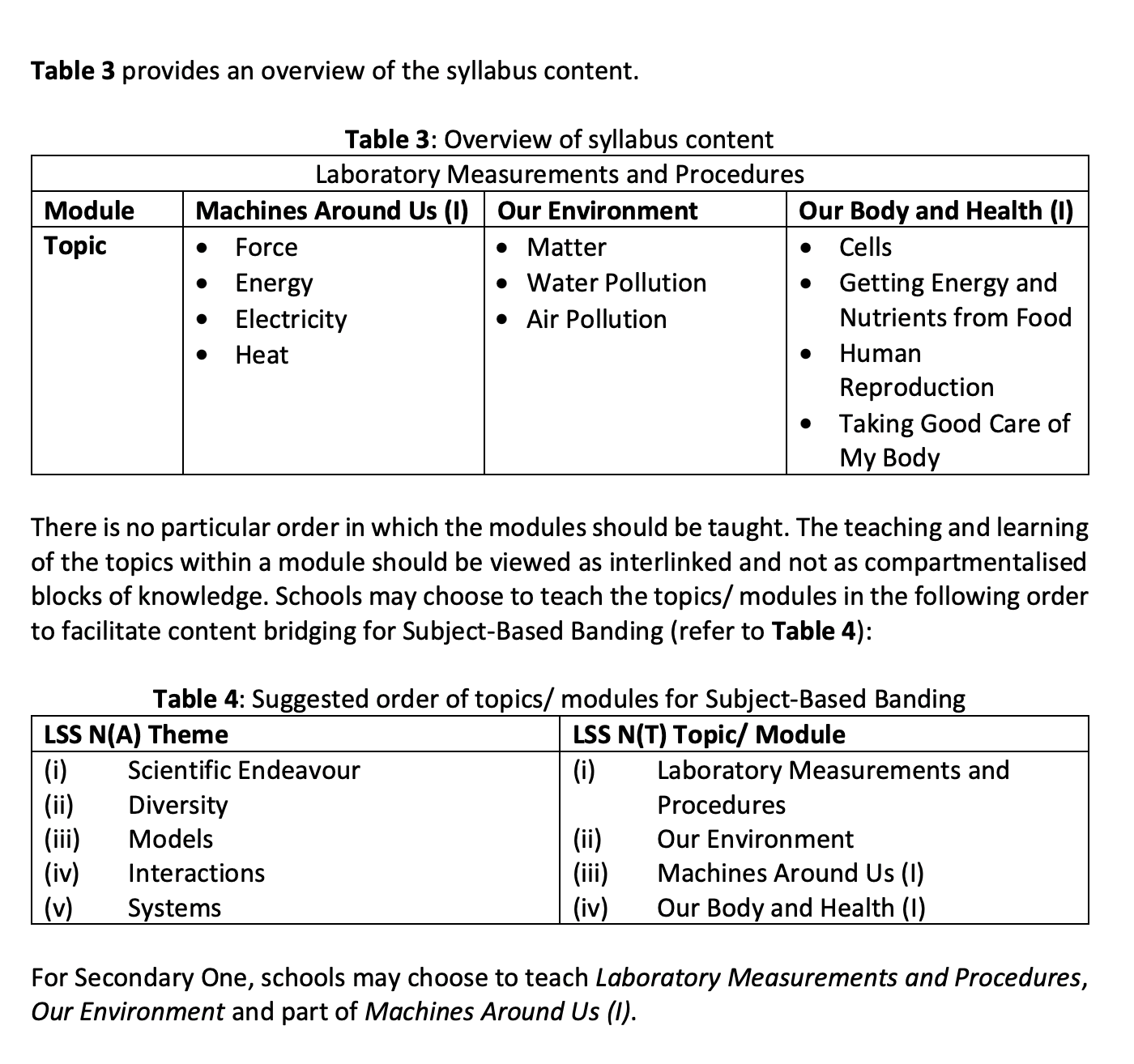
Our fraternity believes that every child wants to and can learn. When children find meaning in learning, they are motivated to take ownership of their own learning. Based on this set of beliefs, the Lower Secondary Normal (Technical) Science syllabus is structured into an introductory topic on Laboratory Measurements and Procedures and three modules, namely Machines Around Us (I), Our Environment, and Our Body and Health (I), that are situated in authentic contexts students can relate to. The contexts draw students into asking questions and seeking knowledge that can help them gain a deeper understanding of the content in each module. For example, from the module Our Body and Health (I), students will wonder why we need to eat and what happen to the food we eat. This would encourage students to engage in self-directed learning where they find out more about how the different body systems work together to release energy from the food we eat.
G2/G3 Syllabus Framework
The G2/G3 Lower Secondary Science syllabuses comprise the Core Ideas, Practices of Science as well as Values, Ethics and Attitudes that all students should acquire to develop scientific literacy. The design of the syllabuses takes into account the time needed for the use of engaging teaching and learning approaches, and the implementation of customised schoolbased programmes that meet the aims of the syllabuses. This enables teachers to make learning more meaningful and enjoyable for students. The features of the G2/G3 Lower Secondary Science syllabuses comprise:
a. Thematic Narrative
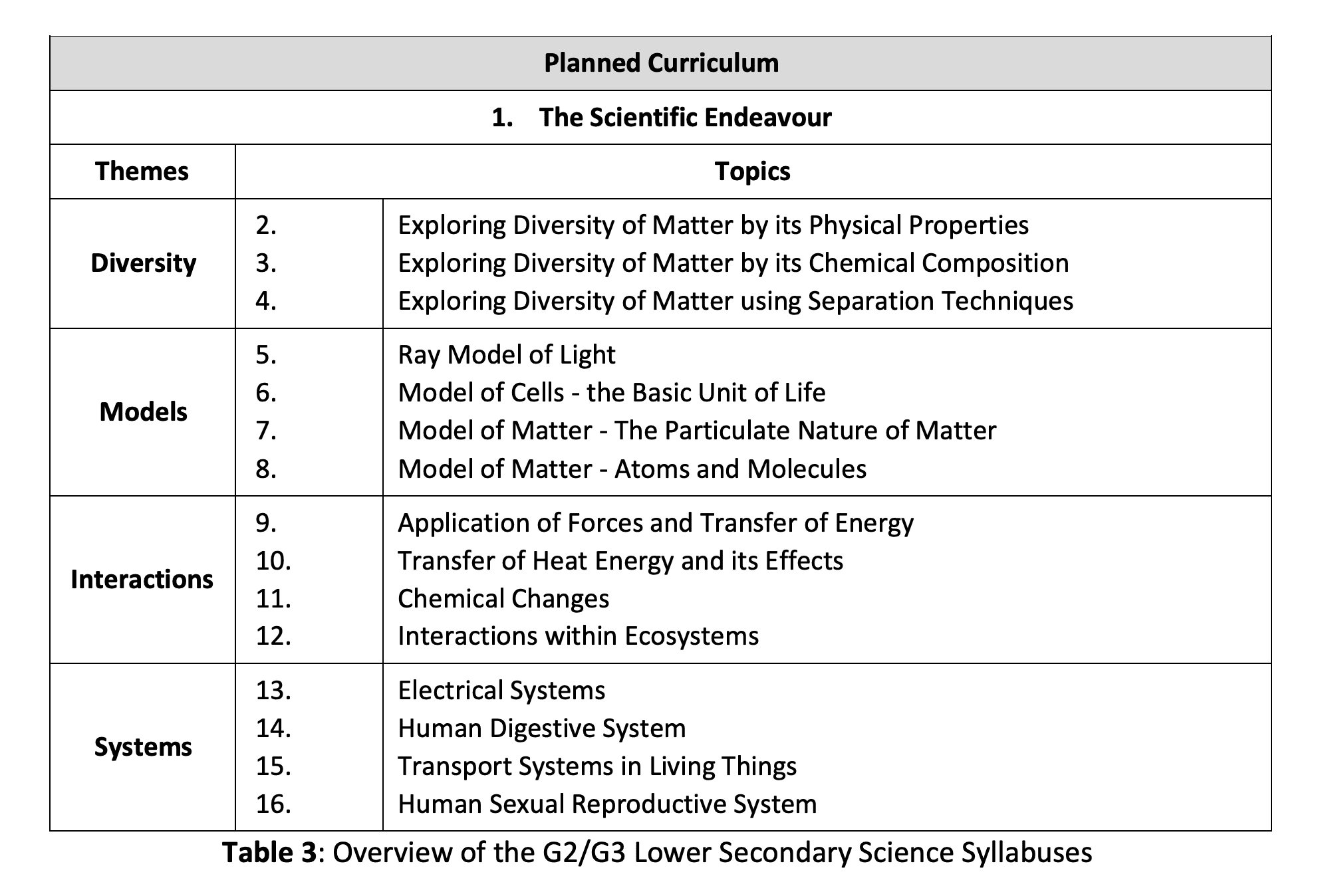
Guided by the Science Curriculum Framework, the G2/G3 LSS curriculum is underpinned by five themes, which is aligned to the Primary Science Syllabus. These themes arise from Core Ideas and Practices of Science, and provide the foundational concepts that students need for the disciplinary sciences (biology, chemistry and physics) at upper secondary. The five themes in the G2/G3 LSS syllabuses are: Scientific Endeavour, Diversity, Models, Interactions and Systems (Table 3).
G2/G3 Student's Curriculum:
THE SCIENTIFIC ENDEAVOUR
DIVERSITY
Exploring Diversity of Matter by its Physical Properties
Exploring Diversity of Matter by its Chemical Composition
Exploring Diversity of Matter using Separation Techniques
MODELS
Ray Model of Light
Model of Cells – the Basic Unit of Life
Model of Matter – The Particulate Nature of Matter
Model of Matter – Atoms and Molecules
INTERACTIONS
Application of Forces and Transfer of Energy
Transfer of Heat Energy and its Effects
Chemical Changes
Interactions within Ecosystems
SYSTEMS
Electrical Systems
Human Digestive System
Transport Systems in Living Things
Human Sexual Reproductive System
Head tutor
Mr. Ahmad Salik
Classes
Sec 1 - 2 (Sunday)
$200 per/month x4 lessons
Semester fee
Secondary Science Curriculum
G1 Syllabus Framework
Our fraternity believes that every child wants to and can learn. When children find meaning in learning, they are motivated to take ownership of their own learning. Based on this set of beliefs, the Lower Secondary Normal (Technical) Science syllabus is structured into an introductory topic on Laboratory Measurements and Procedures and three modules, namely Machines Around Us (I), Our Environment, and Our Body and Health (I), that are situated in authentic contexts students can relate to. The contexts draw students into asking questions and seeking knowledge that can help them gain a deeper understanding of the content in each module. For example, from the module Our Body and Health (I), students will wonder why we need to eat and what happen to the food we eat. This would encourage students to engage in self-directed learning where they find out more about how the different body systems work together to release energy from the food we eat.
G2/G3 Syllabus Framework
The G2/G3 Lower Secondary Science syllabuses comprise the Core Ideas, Practices of Science as well as Values, Ethics and Attitudes that all students should acquire to develop scientific literacy. The design of the syllabuses takes into account the time needed for the use of engaging teaching and learning approaches, and the implementation of customised schoolbased programmes that meet the aims of the syllabuses. This enables teachers to make learning more meaningful and enjoyable for students. The features of the G2/G3 Lower Secondary Science syllabuses comprise:
a. Thematic Narrative
Guided by the Science Curriculum Framework, the G2/G3 LSS curriculum is underpinned by five themes, which is aligned to the Primary Science Syllabus. These themes arise from Core Ideas and Practices of Science, and provide the foundational concepts that students need for the disciplinary sciences (biology, chemistry and physics) at upper secondary. The five themes in the G2/G3 LSS syllabuses are: Scientific Endeavour, Diversity, Models, Interactions and Systems (Table 3).
G2/G3 Student's Curriculum:
THE SCIENTIFIC ENDEAVOUR
DIVERSITY
Exploring Diversity of Matter by its Physical Properties
Exploring Diversity of Matter by its Chemical Composition
Exploring Diversity of Matter using Separation Techniques
MODELS
Ray Model of Light
Model of Cells – the Basic Unit of Life
Model of Matter – The Particulate Nature of Matter
Model of Matter – Atoms and Molecules
INTERACTIONS
Application of Forces and Transfer of Energy
Transfer of Heat Energy and its Effects
Chemical Changes
Interactions within Ecosystems
SYSTEMS
Electrical Systems
Human Digestive System
Transport Systems in Living Things
Human Sexual Reproductive System

Planning to register for AY2027?
Small group, 1-to-1, and customised classes for Primary 3 to Secondary 2 students, aligned with the MOE syllabus. Get in touch to check availability for your child.
Planning to register for AY2027?
Small group, 1-to-1, and customised classes for Primary 3 to Secondary 2 students, aligned with the MOE syllabus. Get in touch to check availability for your child.
Planning to register for AY2027?
Small group, 1-to-1, and customised classes for Primary 3 to Secondary 2 students, aligned with the MOE syllabus. Get in touch to check availability for your child.